
Best Baby Chest Rub 2026: 3 Mentholatum-Free Picks for Sick Days
The best baby chest rub for a congested infant should soothe without exposing your little one to the camphor and menthol that cause respiratory distress in young babies. We screened the mentholatum-free options the way a nurse reads a label: ingredient list first, age approval second, marketing last. All three avoid the adult-formula ingredients the FDA and AAP warn against for infants: Irene Organics Organic Baby Vapor Chest Rub at roughly $18 (our top pick for cleaner-label relief in babies, toddlers, and kids with eucalyptus and lavender oil), the Wellements Organic Baby Chest and Foot Rub at roughly $12 (our best eucalyptus-forward pick, USDA-organic and labeled for 3 months and up), and Vicks BabyRub at roughly $7 (our best classic-formula pick, the only mentholatum-free Vicks formulation, approved for 3+ months). Each baby chest rub here is checked against the American Academy of Pediatrics guidance on cough and cold remedies for young children.
A baby chest rub alone won’t cure a cold — but the right one supports easier breathing during sleep and pairs with the rest of your sick-day toolkit. Per CDC respiratory illness guidance for infants, parents should focus on hydration, gentle humidification, and supportive comfort measures rather than over-the-counter cold medicines, which are not recommended for children under 4. Pair this baby chest rub guide with our top electric nasal aspirators for congestion relief when a cold brings nasal blockage, and use our complete baby fever management kit to make sure the right thermometer, electrolytes, and rub are stocked together for sick-day care.
Best baby chest rub top picks: 3 mentholatum-free formulas
The clean, organic vapor rub with the most transparent ingredient panel, the eucalyptus-forward plant-based formula that comes closest to matching it on label quality and customer-reported soothing (our runner-up for most families), and the only mentholatum-free Vicks formulation — Vicks BabyRub, approved for babies 3+ months and never to be confused with the adult VapoRub formula.
Critical safety warning: never use adult Vicks VapoRub on babies
NEVER use adult Vicks VapoRub on babies — camphor and menthol can cause respiratory distress in infants, including increased mucus production, worsened airway obstruction, and in documented cases life-threatening breathing problems. Use Vicks BabyRub (the mentholatum-free formulation) ONLY for babies 3+ months of age, never on infants under 3 months. This guidance is per the American Academy of Pediatrics and the FDA, and is reinforced by published case reports in the pediatric literature. Camphor in particular is toxic to infants when ingested or absorbed through inflamed skin, and the menthol vapor that “feels cool” to an adult chest can paradoxically increase airway resistance in a baby’s smaller airways.
The best baby chest rub for an infant is one explicitly labeled and tested for the baby age range — that means a clearly mentholatum-free formula, never the adult product applied “in a smaller amount.” Never apply any baby chest rub to broken skin, near the nostrils where it can be inhaled directly, or in the mouth. If your baby has a fever, severe cough, fast breathing, or feeding refusal, call your pediatrician — chest rub is a comfort measure, not a treatment for serious illness.
How we evaluated the best baby chest rubs
A baby chest rub that smells nice but contains the wrong active ingredients can do active harm to a young infant. We screened every formula against published pediatric safety guidance first, and only mentholatum-free, age-appropriate products made the shortlist:
Ingredient and label screening. Every candidate baby chest rub was checked against FDA cough-and-cold guidance for children under 2 and against published pediatric case literature on camphor and menthol toxicity in infants. Products containing camphor in any concentration, menthol above trace levels, or eucalyptus oil at concentrations outside published pediatric-safe ranges were excluded. We also flagged any product whose manufacturer label was unclear on minimum age — a baby chest rub that doesn’t tell you whether it’s safe for a 4-month-old isn’t a product we trust on a 4-month-old.
Irritant screening and texture. Pediatric skin is more permeable than adult skin, so an aromatic baby chest rub that an adult can tolerate without irritation can cause hives or contact dermatitis on a 6-month-old. So we read every ingredient panel for known pediatric irritants and for fragrance ingredients that are not disclosed by source, favoring products whose manufacturers publish the full panel in plain language. Texture — does the rub spread cleanly, does it absorb without leaving a sticky film on pajamas — was judged from the published base ingredients and from aggregated customer reports, because the best baby chest rub is only useful if parents are willing to actually use it.
Best baby chest rubs: side-by-side comparison
| Pick | Product | Key strengths | Watch-outs | Price | Where to buy |
|---|---|---|---|---|---|
| Top Pick | 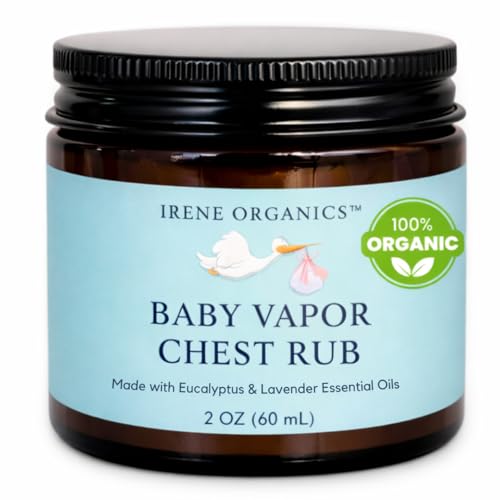 Irene Organics Organic Baby Vapor Chest Rub |
|
| $17.99 | Check price |
| Best Eucalyptus |  Wellements Organic Baby Chest and Foot Rub |
|
| $11.99 | Check price |
| Best Classic (3+ months) |  Vicks BabyRub |
|
| $6.97 | Check price |
Irene Organics Organic Baby Vapor Chest Rub
Wellements Organic Baby Chest and Foot Rub
Vicks BabyRub
Irene Organics Organic Baby Vapor Chest Rub — full breakdown
Irene Organics markets the Organic Baby Vapor Chest Rub as an organic, non-toxic formula built around eucalyptus and lavender essential oils in a shea butter and coconut oil base — not the beeswax base this ASIN shipped with under its previous branding. Per the brand’s own Amazon listing, the formula is free from petroleum, preservatives, parabens, and artificial fragrances, and it doubles as a moisturizer for chest, back, or feet rubs before bedtime.
This is still the chest rub I’d reach for first among the three, though the reasoning is narrower than it used to be: camphor and menthol aren’t on Irene Organics’ published ingredient list, so a formula built from eucalyptus, lavender, shea butter, and coconut oil doesn’t include either of the actives the FDA and AAP warn against. But unlike the product this ASIN used to sell, Irene Organics doesn’t make an explicit “camphor-free” or “menthol-free” claim on its listing — treat the absence from the ingredient list as the fact, not a marketing guarantee. Petroleum, by contrast, is explicitly excluded per the brand’s own listing, along with preservatives, parabens, and artificial fragrances.
The label is straightforward rather than elaborate: five ingredient-and-use bullet points on the Amazon listing name the actives, the base, and the intended use in plain language, and the product ships in a glass amber jar the brand says is chosen to preserve freshness without added preservatives, handcrafted in small batches.
The aroma profile hasn’t changed — eucalyptus and lavender are still the named actives — so it’s still more subtle than the Wellements pick’s eucalyptus-forward formula, with lavender balancing the eucalyptus rather than letting it dominate, which keeps it the easier pick when you want a gentle, sleep-friendly application.
The trade-offs are real but bounded. At $17.99, Irene Organics is roughly 2.5x the cost of Vicks BabyRub and notably more than the Wellements pick — defensible if you value the organic, petroleum-free formulation, harder to justify if you’re cost-conscious. The shea butter and coconut oil base has no bee-derived ingredients, so — unlike this product’s prior formulation — it isn’t a dealbreaker for households avoiding bee products. And like all baby chest rubs, this is a comfort measure, not a cold treatment — pair it with proper hydration, humidification, and a working thermometer before reaching for any rub at all.
Wellements Organic Baby Chest and Foot Rub — full breakdown
The Wellements Organic Baby Chest and Foot Rub is the option for parents who want a single eucalyptus-and-lavender formula, explicitly labeled for babies 3 months and older, at a price point that sits between Irene Organics’ premium tier and Vicks BabyRub’s classic floor. It’s USDA Certified Organic and Non-GMO Project Verified, free of preservatives, artificial colors, artificial fragrances, parabens, menthol, and petroleum — but unlike Irene Organics, the base does contain beeswax, so it isn’t the pick for vegan households or a bee-product allergy. The 2oz jar is sized appropriately for one cold season without ending up with expired product in the back of the medicine cabinet.
The label explicitly covers foot application as well as chest — massage a small amount onto the chest, neck, and feet per the manufacturer’s instructions, which is a genuine point of difference from the chest-only application most other picks describe. For babies in the same 3-months-and-up window as Vicks BabyRub, this and Irene Organics are the two organic options here; the choice between them comes down to aroma (eucalyptus-forward here vs. lavender-balanced with Irene Organics) and whether beeswax is acceptable in your household.
The ingredient panel lists no camphor, no menthol, and no undisclosed fragrance blend, which is what matters most on infant skin. The texture is a moisturizing balm rather than a thin lotion, absorbing at a similar pace to Irene Organics’ shea-butter-and-coconut-oil base.
The organic positioning is documented, not just marketed: USDA Certified Organic and Non-GMO Project Verified status appear directly on the manufacturer’s own listing, alongside the explicit “3 months and older” age guidance and the free-from list (preservatives, artificial colors, artificial fragrances, parabens, menthol, petroleum).
The trade-offs versus Irene Organics come down to base ingredients and aroma rather than safety. This formula is more eucalyptus-forward — if you want a eucalyptus-driven baby chest rub experience, this is the better pick. If you want a beeswax-free, more lavender-balanced blend, Irene Organics wins. At $11.99, the Wellements formula is the best mid-tier value baby chest rub we reviewed for the 3-months-and-up window.
Vicks BabyRub — full breakdown
Vicks BabyRub is the only baby chest rub from the Vicks line that should ever come near a baby. It’s the mentholatum-free, camphor-free formulation explicitly designed for children ages 3 months and up, and it’s the product that fills the gap between “I want a familiar Vicks-style aroma” and “I cannot under any circumstances use the adult VapoRub on my baby.” Per FDA camphor warnings and pediatric case reports, adult VapoRub is genuinely dangerous on infant skin and respiratory systems — BabyRub solves that problem by reformulating with aloe, eucalyptus, lavender, and rosemary fragrance and zero of the actives that cause harm.
Vicks BabyRub wins on raw shelf price and availability, though for a few dollars more the Wellements pick is the better-reviewed rub. At $6.97 for a 1.76oz jar, it’s roughly 44% of Irene Organics’ per-ounce price and roughly 60% the price of the Wellements pick. Wide retail availability — Target, Walmart, Amazon, most US pharmacies — makes this the baby chest rub families are most likely to actually have on hand when a cold appears unexpectedly. The petrolatum base is heavier than the organic oil-based formulations, which some parents preferred for its longer-lasting feel on the chest and others disliked for the residue on pajamas.
The age cutoff is strict. Vicks BabyRub is labeled for babies 3 months and up — never for infants under 3 months — and the manufacturer guidance should be followed without exception.
For infants under 3 months with congestion, the answer is not a smaller amount of BabyRub. The answer is saline drops, gentle suction, humidification, and a pediatrician call — there is no baby chest rub safe for the under-3-month window. For toddlers and older babies in the 3-month-plus range, BabyRub works exactly as labeled and at a price that doesn’t punish families who go through a jar per cold season.
The trade-offs are honest. The petrolatum base is the main aesthetic complaint — it doesn’t feel as “clean” as the organic options, and parents who scrutinize ingredient panels will prefer Irene Organics or the Wellements pick. The aroma is more “classic medicinal” than the warmer organic formulas. On availability and shelf price, Vicks BabyRub remains the dependable classic — but the Wellements pick is the stronger everyday pick when your budget allows the extra few dollars.
5 things to know before buying a baby chest rub
Under 3 months, no baby chest rub is appropriate
Every mentholatum-free baby chest rub on the US market — including Vicks BabyRub — is labeled for ages 3 months and up. For infants under 3 months with congestion, the appropriate interventions are saline drops, gentle bulb or electric suction, humidification, upright feeding positions, and a pediatrician call if breathing is labored or feeding is disrupted. Pair this guidance with our electric nasal aspirator guide for safe under-3-month congestion relief, and never apply any chest rub product to a young infant.
Adult Vicks VapoRub is not a baby chest rub at any age
The single most important safety rule in this category is that adult Vicks VapoRub contains camphor and menthol, both of which are documented to cause respiratory distress, paradoxical airway constriction, and toxicity in infants and young children. Per AAP and FDA guidance, adult VapoRub should not be applied to children under 2 in any quantity. The “BabyRub” formulation is a different product with a different ingredient list — when you reach for a Vicks jar, double-check the label says BabyRub and not VapoRub.
Eucalyptus oil dose matters for very young babies
Eucalyptus essential oil is the active aromatic in most clean baby chest rub formulas, and at the dilutions used in products labeled for 3+ months it’s well-tolerated. But concentrated eucalyptus oil applied directly to infant skin can cause irritation and, in rare cases, neurological effects. Always use a product formulated and labeled specifically for the baby age range — never DIY a baby chest rub by mixing essential oils into coconut oil at home, where the concentration is uncontrolled.
Apply away from the face and never on broken skin
The standard baby chest rub application is a thin layer on the chest, upper back, and sometimes the bottoms of the feet — never on the face, near the nostrils, or on broken or irritated skin. Inhaling concentrated vapor directly is what causes most chest rub adverse events in children. A baby chest rub works by gently scenting the air the baby breathes during sleep, not by being applied close to the airway. Per the AAP cough and cold guidance, chest rub is one of several supportive measures, not a treatment.
Patch-test before first full application
Pediatric skin is more permeable than adult skin, and even a clean organic baby chest rub can trigger contact reactions in sensitive babies. Apply a small dab to the inside of the wrist or behind the ear 24 hours before the first full chest application, and watch for redness, warmth, or hives. If anything appears, switch products or skip chest rub entirely for that child. Stock the baby chest rub you choose alongside everything in our complete baby fever management kit so it’s ready before a cold appears.
Best baby chest rub: frequently asked questions
No — never use adult Vicks VapoRub on a baby. Adult VapoRub contains camphor and menthol, both of which can cause respiratory distress, increased mucus production, and paradoxical airway constriction in infants and young children. The only Vicks formulation safe to consider for babies is Vicks BabyRub, which is mentholatum-free and labeled for ages 3 months and up. For infants under 3 months, no chest rub product is appropriate — use saline drops, gentle suction, and humidification instead, and call your pediatrician for any concerning symptoms.
For a 3-month-old, the best baby chest rub is one explicitly labeled for the 3+ month age range with a mentholatum-free, camphor-free formula. Among the picks we compared, the top three were Irene Organics Organic Baby Vapor Chest Rub (our top pick for cleaner-label relief), the Wellements Organic Baby Chest and Foot Rub (best mid-tier eucalyptus-forward pick, USDA organic, labeled for 3 months and up), and Vicks BabyRub (the budget classic and the only mentholatum-free Vicks formula). Apply a thin layer to the chest and upper back per manufacturer instructions, never on the face or near the nostrils.
No — every mentholatum-free baby chest rub on the US market, including Vicks BabyRub, is labeled for ages 3 months and up. There is no chest rub product approved for newborns under 3 months. For congestion in young infants, use saline nasal drops, an electric or bulb nasal aspirator, cool-mist humidification, and upright feeding positions.
If your newborn is struggling to breathe, refusing feeds, running a rectal fever of 100.4°F or higher, or showing fast breathing, call your pediatrician immediately — these are not symptoms a baby chest rub treats. Always consult the AAP guidance at HealthyChildren.org for any concerning infant respiratory symptoms.
The two ingredients to avoid in any baby chest rub are camphor and menthol, both of which are documented to cause respiratory distress, paradoxical airway constriction, and in some cases neurotoxicity in infants and young children. The FDA explicitly warns against camphor exposure in children under 2. Mentholatum is the trade name historically associated with these actives — a mentholatum-free baby chest rub contains neither, which is what you want. Other ingredients worth scrutinizing are high concentrations of essential oils (always use products specifically formulated and labeled for the baby age range), petroleum derivatives if you prefer organic formulations, and fragrances that don’t disclose source ingredients.
Apply a thin layer of baby chest rub to the chest, upper back, and sometimes the bottoms of the feet (covered with socks) — never on the face, never near the nostrils, never in or near the mouth, and never on broken or irritated skin. The vapor works by gently scenting the air the baby breathes during sleep, not by being applied directly to the airway.
The standard application timing is roughly 30 minutes before bedtime, allowing the aroma to develop while you finish the bedtime routine. If your baby has any skin irritation or rash, skip the application entirely until skin is fully healed. Per AAP and CDC guidance, baby chest rub is a comfort measure during a cold — not a treatment — so don’t expect it to shorten illness duration.
Baby chest rubs work as a comfort measure, not a cold treatment. The pediatric literature on chest rubs (mostly studied in older children with mentholated formulas) suggests modest improvements in subjective sleep quality and parent-rated cough discomfort during the application night, with no effect on actual cold duration or severity. For mentholatum-free formulas designed for babies, the mechanism is gentler — calming aroma and the comfort cue of a familiar pre-sleep ritual rather than active decongestion.
If your baby has a persistent cough, fast breathing, fever, or feeding difficulty, the right intervention is a pediatrician call — not more baby chest rub. Pair the best baby chest rub with our top pedialyte alternatives for hydration support during illness, since fluid intake matters more for cold recovery than any topical product.
Our #1 best baby chest rub pick: Irene Organics Organic Baby Vapor Chest Rub
A petroleum-free, organic mentholatum-free baby chest rub with eucalyptus and lavender essential oils in a shea butter and coconut oil base that spreads cleanly on small chests without sticky residue — camphor and menthol don’t appear on the ingredient list, though the brand doesn’t make an explicit “camphor-free” claim. For babies, toddlers, and kids in the 3+ month range it’s the everyday workhorse — pair it with a jar of the USDA-organic Wellements Organic Baby Chest and Foot Rub as your second-line soother and a working electric nasal aspirator for the under-3-month window, and you have a complete cold-and-cough support setup ready before the next cold hits.
Medical disclaimer: Not medical advice. Baby chest rub selection and use should always be made in consultation with your child’s pediatrician, especially for infants near the 3-month label cutoff, babies with eczema or sensitive skin, or any child with persistent cough, fast breathing, fever above 100.4°F, or feeding refusal. The information here is educational and reflects current clinical guidance as of the last review date. Consult HealthyChildren.org (AAP), the FDA, and the CDC for additional pediatric guidance.
Prices: Reflect typical Amazon pricing as of May 2026 and may vary. Manufacturer formulations occasionally change — verify the ingredient panel on the linked product page before ordering. The pediatric chest rub safety literature referenced is available via PubMed (NCBI).
- Silverberg NB. Pediatric Contact Dermatitis. Medscape Drugs & Diseases (eMedicine); updated Mar 19, 2026. Contact dermatitis affects at least a quarter of children; irritant injury damages the protective upper epidermis, and skin protection with emollients is advised.